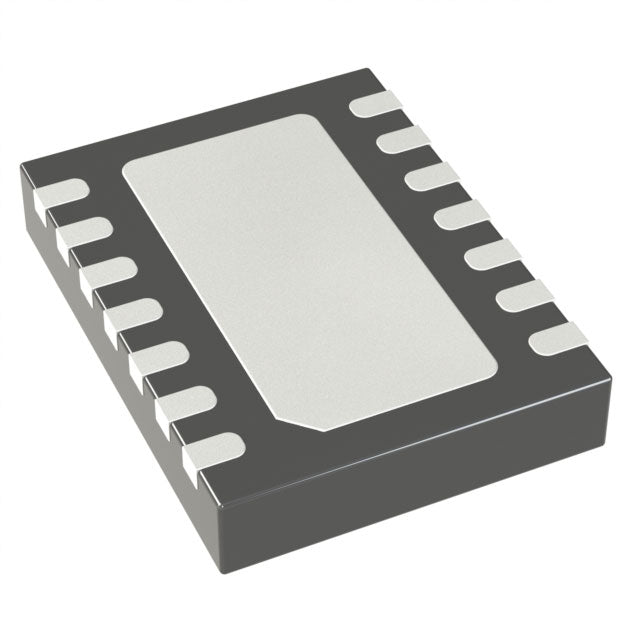
Analog Devices Inc. LTC2489CDE#PBF

| Quantity | Unit Price | Total Price |
|---|---|---|
| 1 | $7.37 | $7.37 |
| 15+ | $7.14 | $107.10 |
| 25+ | $6.98 | $174.50 |
| 50+ | $6.60 | $330.00 |
| 100+ | $5.82 | $582.00 |
| N+ | $1.16 | Price Inquiry |
Request Quote / Inquiry
| Product attributes | Property Value |
| Manufacturer | Analog Devices Inc. |
| Product Series | |
| Packaging | Tube | |
| Number of Bits | 16 |
| Sampling Rate (Per Second) | 7.5 |
| Number of Inputs | 2, 4 |
| Input Type | Differential, Single Ended |
| Data Interface | I2C |
| Configuration | MUX-ADC |
| Ratio - S/H:ADC | - |
| Number of A/D Converters | 1 |
| Architecture | Sigma-Delta |
| Reference Type | External |
| Voltage - Supply, Analog | 2.7V ~ 5.5V |
| Voltage - Supply, Digital | 2.7V ~ 5.5V |
| Features | PGA, Selectable Address |
| Operating Temperature | 0°C ~ 70°C |
| Mounting Type | Surface Mount |
| Grade | - |
| Qualification | - |
| Package / Case | 14-WFDFN Exposed Pad |
| Supplier Device Package | 14-DFN (4x3) |
| ROHS |  |
The LTC2489CDE#PBF is a 16-bit, high-precision analog-to-digital converter (ADC) from Analog Devices. It offers a sampling rate of 7.5 SPS and includes a 2/4-channel input multiplexer. This device communicates via a standard I2C interface, making it easy to integrate into systems with multiple digital devices. It operates over a 0°C to 70°C temperature range. The LTC2489 is designed for precision measurement applications such as sensor networks, medical instrumentation, and environmental monitoring.
- High-Resolution Accuracy: 16-bit resolution ensures precise digitization of analog signals, critical for measurement and control.
- Convenient I2C Interface: The I2C bus allows for easy connection to microcontrollers and supports multiple devices on a single bus.
- Integrated Multiplexer: The 2/4-channel MUX enables monitoring of multiple sensors without external switching components.
- Low Power Consumption: Suitable for battery-powered and portable applications where power efficiency is key.
Precision Sensor Networks
The 16-bit resolution and I2C interface make it perfect for building distributed sensor networks where multiple devices share a common bus.
Data Acquisition Systems
Its high accuracy and 4-channel MUX are ideal for laboratory data acquisition systems that need to monitor multiple analog signals.
Medical Instrumentation
The low sampling rate and high precision are suitable for medical devices like patient monitors and diagnostic equipment that require accurate readings.
Environmental Monitoring
It can be used in weather stations or environmental loggers to precisely measure temperature, humidity, and pressure over long periods.
Industrial Calibration Equipment
The high resolution makes it suitable for calibration tools and reference instruments that demand exceptional accuracy.
- Q: What is the resolution of the LTC2489CDE#PBF?
- A: It is a 16-bit analog-to-digital converter (ADC).
- Q: What is the sampling rate?
- A: The sampling rate is 7.5 SPS (samples per second).
- Q: How many input channels does it have?
- A: It has a multiplexed input with 2 or 4 channels.
- Q: What digital interface does it use?
- A: It uses an I2C (Inter-Integrated Circuit) interface.
- Q: What is the ADC architecture?
- A: It uses a MUX-ADC architecture, combining an input multiplexer with a high-precision delta-sigma converter.
- Q: What is the operating temperature range?
- A: It operates from 0°C to 70°C.
 LTC2489CDE#PBF.pdf
- Q: What is the resolution of the LTC2489CDE#PBF?
- A: It is a 16-bit analog-to-digital converter (ADC).
- Q: What is the sampling rate?
- A: The sampling rate is 7.5 SPS (samples per second).
- Q: How many input channels does it have?
- A: It has a multiplexed input with 2 or 4 channels.
- Q: What digital interface does it use?
- A: It uses an I2C (Inter-Integrated Circuit) interface.
- Q: What is the ADC architecture?
- A: It uses a MUX-ADC architecture, combining an input multiplexer with a high-precision delta-sigma converter.
- Q: What is the operating temperature range?
- A: It operates from 0°C to 70°C.