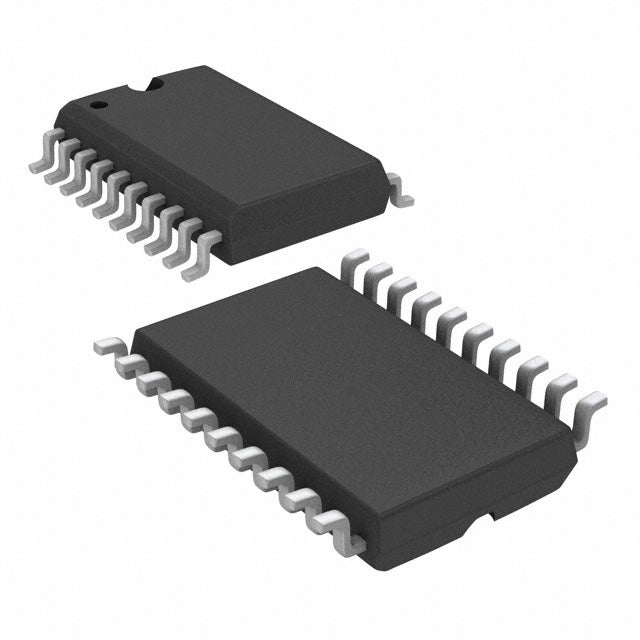
Texas Instruments SN74LVC2244ADWR

| Quantity | Unit Price | Total Price |
|---|---|---|
| 1 | $0.52 | $0.52 |
| 15+ | $0.51 | $7.65 |
| 25+ | $0.50 | $12.50 |
| 50+ | $0.47 | $23.50 |
| 100+ | $0.41 | $41.00 |
| N+ | $0.08 | Price Inquiry |
Request Quote / Inquiry
| Product attributes | Property Value |
| Manufacturer | Texas Instruments |
| Product Series | 74LVC |
| Packaging | Marketplace | Cut Tape (CT) |
| Part Status | Active |
| Logic Type | Buffer, Non-Inverting |
| Number of Elements | 2 |
| Number of Bits per Element | 4 |
| Input Type | - |
| Output Type | 3-State |
| Current - Output High, Low | 12mA, 12mA |
| Voltage - Supply | 1.65V ~ 3.6V |
| Operating Temperature | -40°C ~ 85°C (TA) |
| Grade | - |
| Qualification | - |
| Mounting Type | Surface Mount |
| Package / Case | 20-SOIC (0.295", 7.50mm Width) |
| Supplier Device Package | 20-SOIC |
| ROHS |  |
The SN74LVC2244A is a dual non-inverting buffer from Texas Instruments, featuring 3-state outputs and low-voltage CMOS technology. Operating from 1.65V to 3.6V, it provides 12mA sink/source current, making it ideal for high-speed bus driving in 1.8V to 3.3V systems. The 20-SOIC package offers a compact footprint for consumer electronics, networking gear, and memory interfaces.
- Wide Low-Voltage Range (1.65V-3.6V): Supports 1.8V, 2.5V, and 3.3V logic, reducing BOM complexity.
- High Drive Current (12mA): Ensures signal integrity on high-capacitance buses.
- 3-State Outputs: Facilitates bus sharing in multi-master systems.
- Low Power Consumption: Ideal for battery-operated devices.
- Industry-Standard 20-SOIC Package: Easy to integrate into existing PCB designs.
Low-Voltage Bus Interfacing
The 1.65V-3.6V range allows direct connection to 1.8V FPGAs or 2.5V DSPs, eliminating external level shifters.
DDR Memory Address Buffering
With 12mA drive and fast propagation, it can buffer address/control lines in DDR3/DDR4 memory modules.
Portable Consumer Electronics
Low power consumption and 3.3V operation make it ideal for smartphones, tablets, and wearables.
Server Motherboard Signal Distribution
High drive current (12mA) ensures clean signal transmission across long traces in high-speed server backplanes.
FPGA Configuration Loading
Buffering configuration bitstreams with 3-state control prevents bus contention during multi-FPGA programming.
Networking Equipment
Wide temperature range (-40°C to 85°C) supports reliable operation in routers and switches.
- Q: What is the logic family of the SN74LVC2244A?
- A: It belongs to the 74LVC (Low-Voltage CMOS) family from Texas Instruments, optimized for low-power 3.3V systems.
- Q: What is the function of this IC?
- A: It is a non-inverting buffer with 3-state outputs, designed for high-speed signal buffering.
- Q: How many channels does it have?
- A: It features 2 channels, providing dual independent buffering paths.
- Q: What is the output type?
- A: The outputs are 3-State, allowing high, low, or high-impedance states for bus isolation.
- Q: What is the operating voltage range?
- A: It operates from 1.65V to 3.6V, supporting low-voltage logic including 1.8V and 2.5V systems.
- Q: What package is available?
- A: It is available in a 20-SOIC package with a 7.50mm body width, suitable for standard PCB assembly.
 SN74LVC2244ADWR.pdf
- Q: What is the logic family of the SN74LVC2244A?
- A: It belongs to the 74LVC (Low-Voltage CMOS) family from Texas Instruments, optimized for low-power 3.3V systems.
- Q: What is the function of this IC?
- A: It is a non-inverting buffer with 3-state outputs, designed for high-speed signal buffering.
- Q: How many channels does it have?
- A: It features 2 channels, providing dual independent buffering paths.
- Q: What is the output type?
- A: The outputs are 3-State, allowing high, low, or high-impedance states for bus isolation.
- Q: What is the operating voltage range?
- A: It operates from 1.65V to 3.6V, supporting low-voltage logic including 1.8V and 2.5V systems.
- Q: What package is available?
- A: It is available in a 20-SOIC package with a 7.50mm body width, suitable for standard PCB assembly.