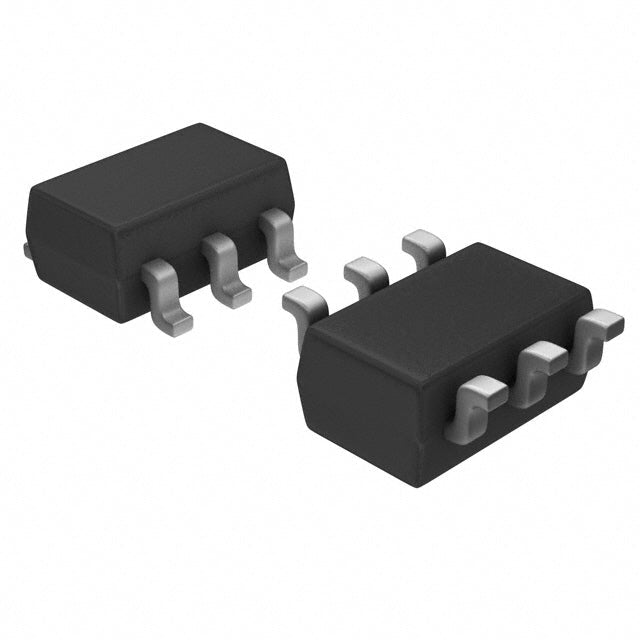
Texas Instruments SN74LVC2G17DBVT

| Quantity | Unit Price | Total Price |
|---|---|---|
| 1 | $1.05 | $1.05 |
| 15+ | $1.02 | $15.30 |
| 25+ | $1.00 | $25.00 |
| 50+ | $0.94 | $47.00 |
| 100+ | $0.83 | $83.00 |
| N+ | $0.17 | Price Inquiry |
Request Quote / Inquiry
| Product attributes | Property Value |
| Manufacturer | Texas Instruments |
| Product Series | 74LVC |
| Packaging | Cut Tape (CT) | Tape & Reel (TR) |
| Part Status | Active |
| Logic Type | Buffer, Non-Inverting |
| Number of Elements | 2 |
| Number of Bits per Element | 1 |
| Input Type | Schmitt Trigger |
| Output Type | Push-Pull |
| Current - Output High, Low | 32mA, 32mA |
| Voltage - Supply | 1.65V ~ 5.5V |
| Operating Temperature | -40°C ~ 125°C (TA) |
| Grade | - |
| Qualification | - |
| Mounting Type | Surface Mount |
| Package / Case | SOT-23-6 |
| Supplier Device Package | SOT-23-6 |
| ROHS |  |
The SN74LVC2G17 is a dual non-inverting buffer from Texas Instruments, featuring Schmitt-trigger inputs for enhanced noise immunity. This 74LVC device operates from 1.65V to 5.5V and provides push-pull outputs capable of sourcing and sinking 32mA. The hysteresis built into the inputs makes it ideal for conditioning slow or noisy signals. Packaged in a compact SOT-23-6, it is perfect for space-constrained applications requiring reliable signal shaping.
- Schmitt-Trigger Inputs: Provides hysteresis for noise immunity, ensuring stable operation in electrically noisy environments.
- Wide Supply Range (1.65V to 5.5V): Compatible with both 3.3V and 5V systems, simplifying power supply design.
- Push-Pull Outputs (32mA): Can drive LEDs or high-capacitance loads directly, offering strong signal integrity.
- Compact SOT-23-6 Package: Saves board space in portable and high-density electronic designs.
Noise-Immune Signal Conditioning
The Schmitt-trigger inputs provide hysteresis, which cleans up slow or noisy input signals. This is critical in industrial environments where electromagnetic interference (EMI) can corrupt logic levels.
Interfacing with Slow-Edge Sensors
When connecting sensors with slow rise/fall times (e.g., thermistors, photodiodes), the Schmitt trigger ensures a clean, fast transition at the output, preventing multiple triggering and erratic behavior.
Oscillator Circuits
The hysteresis of the Schmitt trigger can be used to build simple RC relaxation oscillators. This buffer can serve as the active element in a square-wave generator for timing or clock applications.
Pulse Shaping for Communication Lines
For serial communication lines (UART, SPI), this buffer can reshape degraded pulses, restoring sharp edges and ensuring reliable data transmission over longer traces.
Automotive ECU Input Protection
In automotive ECUs, signals from switches and sensors can be noisy. The Schmitt-trigger buffer filters this noise, providing a clean signal to the microcontroller and preventing false triggering.
Level Shifting with Push-Pull Outputs
When powered from a 3.3V rail, the push-pull output can drive 5V TTL inputs directly, as the high-level output voltage (VOH) is sufficient for TTL logic thresholds.
- Q: What is the logic family of the SN74LVC2G17DBVT?
- A: It belongs to the 74LVC logic family, known for low-voltage and high-speed operation.
- Q: What is the function of this IC?
- A: It is a dual non-inverting buffer with Schmitt-trigger inputs, providing hysteresis for noise immunity.
- Q: How many channels does it have?
- A: It contains 2 independent buffer channels.
- Q: What is the output type?
- A: The outputs are push-pull, capable of both sourcing and sinking current.
- Q: What is the voltage range?
- A: It operates from 1.65V to 5.5V, making it versatile for various logic levels.
- Q: What package is available?
- A: It is offered in a SOT-23-6 package, which is very small and suitable for compact designs.
 SN74LVC2G17DBVT.pdf
- Q: What is the logic family of the SN74LVC2G17DBVT?
- A: It belongs to the 74LVC logic family, known for low-voltage and high-speed operation.
- Q: What is the function of this IC?
- A: It is a dual non-inverting buffer with Schmitt-trigger inputs, providing hysteresis for noise immunity.
- Q: How many channels does it have?
- A: It contains 2 independent buffer channels.
- Q: What is the output type?
- A: The outputs are push-pull, capable of both sourcing and sinking current.
- Q: What is the voltage range?
- A: It operates from 1.65V to 5.5V, making it versatile for various logic levels.
- Q: What package is available?
- A: It is offered in a SOT-23-6 package, which is very small and suitable for compact designs.