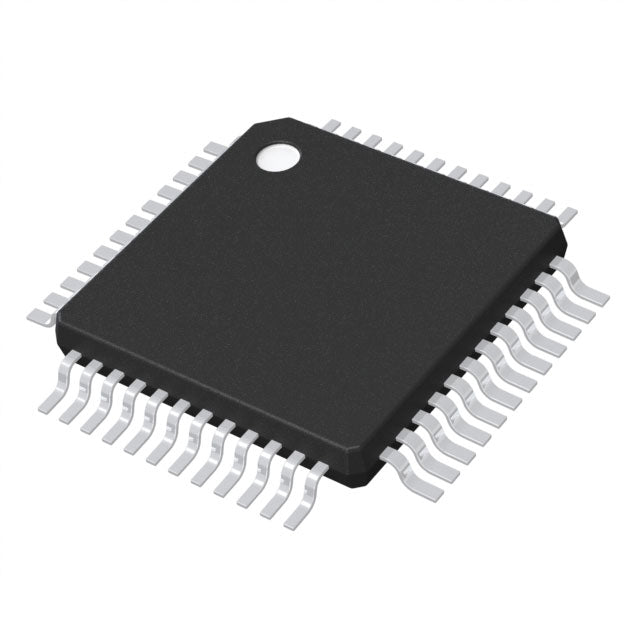
STMicroelectronics STM32L462CET6

| Quantity | Unit Price | Total Price |
|---|---|---|
| 1 | $15.92 | $15.92 |
| 15+ | $3.66 | $54.90 |
| 25+ | $3.58 | $89.50 |
| 50+ | $3.38 | $169.00 |
| 100+ | $2.99 | $299.00 |
| N+ | $0.60 | Price Inquiry |
Request Quote / Inquiry
| Product attributes | Property Value |
| Manufacturer | STMicroelectronics |
| Product Series | STM32L4 |
| Packaging | Bulk | NULL |
| Core Processor | ARM® Cortex®-M4 |
| Core Size | 32-Bit Single-Core |
| Speed | 80MHz |
| Connectivity | CANbus, I2C, IrDA, LINbus, MMC/SD, QSPI, SAI, SPI, UART/USART, USB |
| Peripherals | Brown-out Detect/Reset, DMA, PWM, WDT |
| Number of I/O | 38 |
| Program Memory Size | 512KB (512K x 8) |
| Program Memory Type | FLASH |
| EEPROM Size | - |
| RAM Size | 160K x 8 |
| Voltage - Supply (Vcc/Vdd) | 1.71V ~ 3.6V |
| Data Converters | A/D 10x12b SAR; D/A 1x12b |
| Oscillator Type | Internal |
| Operating Temperature | -40°C ~ 85°C (TA) |
| Grade | - |
| Qualification AEC | - |
| Mounting Type | Surface Mount |
| Supplier Device Package | 48-LQFP (7x7) |
| Package / Case | 48-LQFP |
| ROHS |  |
The STM32L462CET6 is an ultra-low-power 32-bit microcontroller from STMicroelectronics, featuring an ARM Cortex-M4 core at 80MHz. It offers 512KB flash and 160KB SRAM, providing generous memory for complex firmware. Operating from 1.71V to 3.6V, it is optimized for energy-efficient applications. The 48-LQFP package ensures easy integration into industrial and consumer designs. With DMA, PWM, WDT, and brown-out detection, it delivers robust performance for battery-operated and real-time systems.
- Ultra-low-power architecture: Extends battery life with multiple low-power modes and efficient 80MHz operation.
- Large 512KB flash: Supports over-the-air updates and complex application code without external storage.
- High RAM capacity (160KB): Enables rich data logging and multitasking capabilities.
- Wide voltage range (1.71V-3.6V): Compatible with various battery chemistries and power sources.
Battery-Powered Sensor Nodes
With 1.71V minimum supply and ultra-low-power stop modes, it can run for years on a coin cell in environmental monitoring applications.
Smart Meters
The 512KB flash allows for complex metrology algorithms and communication protocol stacks for gas, water, or electricity meters.
Medical Wearables
Its 80MHz Cortex-M4 can process ECG or glucose sensor data while maintaining low power for continuous health monitoring.
Industrial Process Controllers
With PWM and WDT, it can handle PID control loops for temperature or pressure regulation in manufacturing plants.
Asset Tracking Devices
160KB RAM supports GPS and cellular modem buffering, enabling real-time location reporting with extended battery life.
Home Automation Controllers
The 48-LQFP package and rich GPIOs make it suitable for central control units in smart lighting or security systems.
- Q: What is the operating frequency of the STM32L462CET6?
- A: It runs at 80MHz on an ARM Cortex-M4 core with FPU, balancing performance and power efficiency.
- Q: How much memory is available?
- A: It has 512KB flash and 160KB RAM, ideal for applications requiring large code and data storage.
- Q: What is the package type?
- A: It comes in a 48-LQFP package, which is easy to solder and suitable for prototyping and production.
- Q: Does it have low-power modes?
- A: Yes, it features multiple low-power modes including sleep, stop, and standby, with typical consumption in the microamp range.
 STM32L462CET6.pdf
- Q: What is the operating frequency of the STM32L462CET6?
- A: It runs at 80MHz on an ARM Cortex-M4 core with FPU, balancing performance and power efficiency.
- Q: How much memory is available?
- A: It has 512KB flash and 160KB RAM, ideal for applications requiring large code and data storage.
- Q: What is the package type?
- A: It comes in a 48-LQFP package, which is easy to solder and suitable for prototyping and production.
- Q: Does it have low-power modes?
- A: Yes, it features multiple low-power modes including sleep, stop, and standby, with typical consumption in the microamp range.