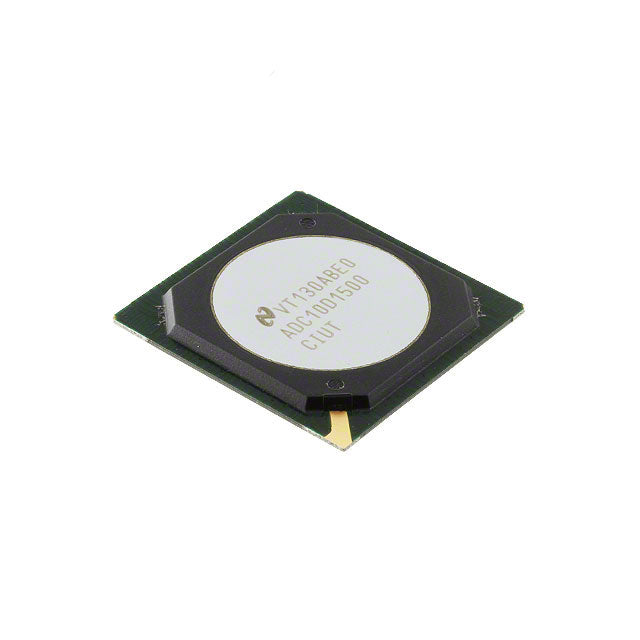
Texas Instruments ADC12D800RFIUT/NOPB

| Quantity | Unit Price | Total Price |
|---|---|---|
| 1 | $1,214.86 | $1,214.86 |
| 15+ | $1,176.50 | $17,647.50 |
| 25+ | $1,150.92 | $28,773.00 |
| 50+ | $1,086.98 | $54,349.00 |
| 100+ | $959.10 | $95,910.00 |
| N+ | $191.82 | Price Inquiry |
Request Quote / Inquiry
| Product attributes | Property Value |
| Manufacturer | Texas Instruments |
| Product Series | |
| Packaging | Marketplace | Tray |
| Number of Bits | 12 |
| Sampling Rate (Per Second) | 1.6G |
| Number of Inputs | 2 |
| Input Type | Differential |
| Data Interface | LVDS - Parallel |
| Configuration | MUX-S/H-ADC |
| Ratio - S/H:ADC | 1:1 |
| Number of A/D Converters | 2 |
| Architecture | Folding Interpolating |
| Reference Type | Internal |
| Voltage - Supply, Analog | 1.8V ~ 2V |
| Voltage - Supply, Digital | 1.8V ~ 2V |
| Features | Simultaneous Sampling |
| Operating Temperature | -40°C ~ 85°C |
| Mounting Type | Surface Mount |
| Grade | - |
| Qualification | - |
| Package / Case | 292-BBGA |
| Supplier Device Package | 292-BGA (27x27) |
| ROHS |  |
The Texas Instruments ADC12D800RFIUT/NOPB is a 12-bit, dual-channel ADC with an exceptional 1.6 GSPS sampling rate. Featuring an LVDS-parallel interface and MUX-S/H-ADC architecture, it delivers ultra-high-speed conversion for demanding RF and instrumentation applications. Operating from -40°C to 85°C in a 292-BBGA package, this converter is ideal for radar, communications, and scientific research.
- Ultra-High Sampling Rate: 1.6 GSPS enables direct RF sampling, eliminating multiple analog mixing stages.
- Dual-Channel Operation: Two inputs allow simultaneous I/Q sampling or interleaved single-channel use for higher throughput.
- Low-Noise LVDS Output: Differential signaling reduces electromagnetic interference in high-speed digital systems.
- Advanced Architecture: MUX-S/H-ADC design maintains signal integrity at gigahertz frequencies.
Ultra-Wideband Radar Systems
The 1.6 GSPS sampling rate and 12-bit resolution allow direct digitization of wideband RF signals, enabling high-resolution target detection in automotive and defense radar.
5G/6G Communication Test Equipment
Dual-channel LVDS output supports high-speed data transfer for analyzing complex modulated signals in base station testing.
High-Energy Physics Experiments
The MUX-S/H-ADC architecture handles fast transient pulses from particle detectors, with 2 channels for simultaneous measurement of different sensor arrays.
Satellite Communication Ground Stations
Direct RF sampling at 1.6 GSPS simplifies receiver architectures, reducing analog downconversion stages and improving signal fidelity.
Advanced Medical Imaging (PET/CT)
High-speed conversion of scintillator pulses enables precise timing and energy measurement for positron emission tomography.
- Q: What is the resolution of the ADC12D800RFIUT/NOPB?
- A: It is a 12-bit ADC, offering 4096 levels of digital output.
- Q: What is the maximum sampling rate?
- A: It supports a sampling rate of 1.6 GSPS (giga-samples per second), enabling ultra-high-speed signal capture.
- Q: How many channels does it have?
- A: It has 2 input channels, supporting dual-channel interleaved or independent conversion.
- Q: What interface does it use?
- A: It uses an LVDS - Parallel interface for high-speed, low-noise digital output.
- Q: What is the architecture?
- A: The architecture is MUX-S/H-ADC (Multiplexed Sample-and-Hold ADC), optimized for high bandwidth.
- Q: What is the package and temperature range?
- A: It comes in a 292-BBGA package and operates from -40°C to 85°C.
 ADC12D800RFIUT/NOPB.pdf
- Q: What is the resolution of the ADC12D800RFIUT/NOPB?
- A: It is a 12-bit ADC, offering 4096 levels of digital output.
- Q: What is the maximum sampling rate?
- A: It supports a sampling rate of 1.6 GSPS (giga-samples per second), enabling ultra-high-speed signal capture.
- Q: How many channels does it have?
- A: It has 2 input channels, supporting dual-channel interleaved or independent conversion.
- Q: What interface does it use?
- A: It uses an LVDS - Parallel interface for high-speed, low-noise digital output.
- Q: What is the architecture?
- A: The architecture is MUX-S/H-ADC (Multiplexed Sample-and-Hold ADC), optimized for high bandwidth.
- Q: What is the package and temperature range?
- A: It comes in a 292-BBGA package and operates from -40°C to 85°C.