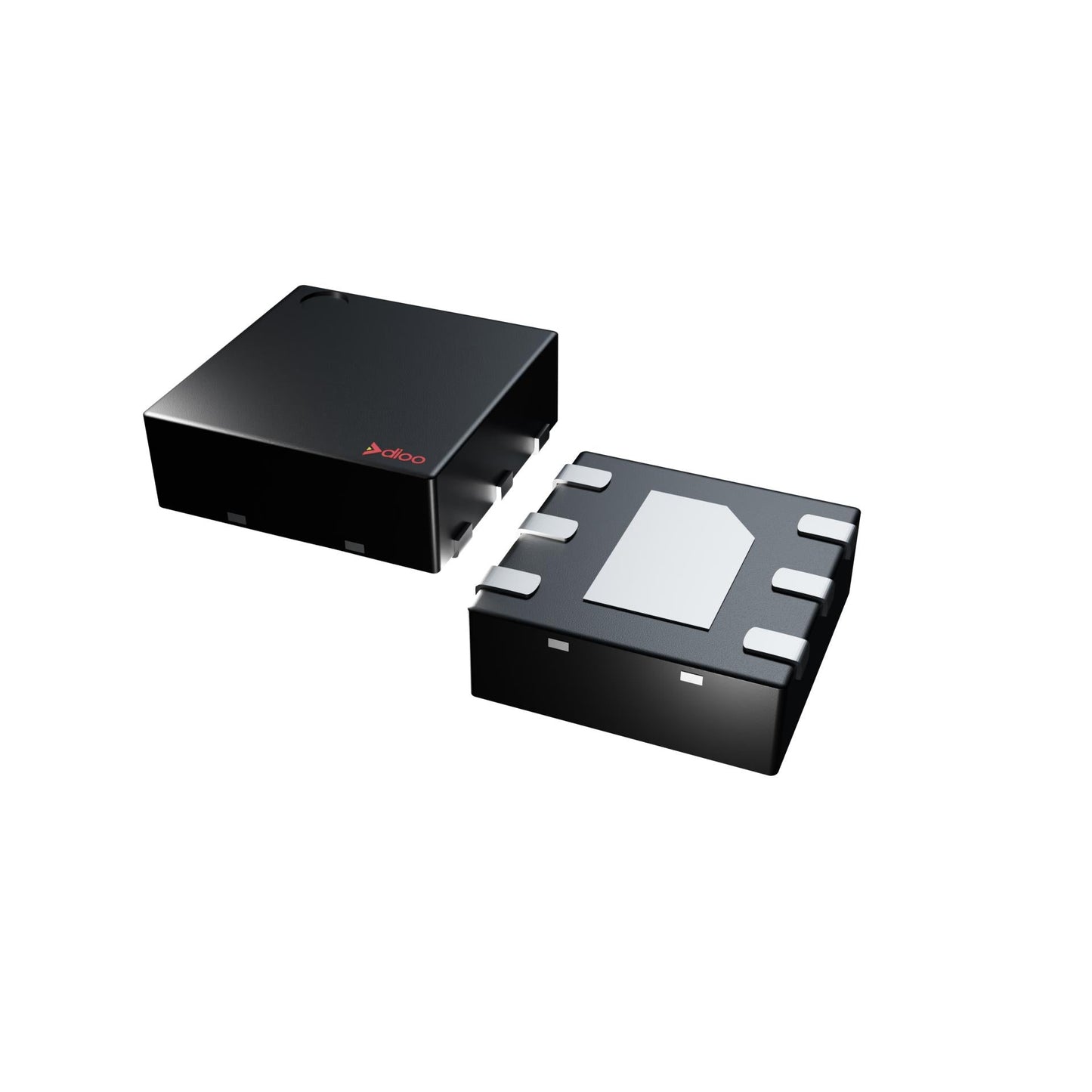
Dioo Microcircuits Co., Ltd. DIO6199DN6

| Quantity | Unit Price | Total Price |
|---|---|---|
| 1 | $4.00 | $4.00 |
| 15+ | $0.92 | $13.80 |
| 25+ | $0.90 | $22.50 |
| 50+ | $0.85 | $42.50 |
| 100+ | $0.75 | $75.00 |
| N+ | $0.15 | Price Inquiry |
Request Quote / Inquiry
| Product attributes | Property Value |
| Manufacturer | Dioo Microcircuits Co., Ltd. |
| Product Series | |
| Packaging | Tape & Reel (TR) | |
| Function | Step-Up |
| Output Configuration | Positive |
| Topology | Boost |
| Output Type | Adjustable |
| Number of Outputs | 1 |
| Voltage - Input (Min) | 1.1V |
| Voltage - Input (Max) | 5.5V |
| Voltage - Output (Min/Fixed) | 2V |
| Voltage - Output (Max) | 5.5V |
| Current - Output | - |
| Frequency - Switching | 1MHz |
| Synchronous Rectifier | Yes |
| Operating Temperature | -40°C ~ 150°C (TJ) |
| Grade | - |
| Qualification | - |
| Mounting Type | Surface Mount |
| Package / Case | 6-WDFN Exposed Pad |
| Supplier Device Package | 6-DFN (2x2) |
The DIO6199DN6 from Dioo Microcircuits is a step-up (Boost) DC-DC converter designed to generate higher output voltages from low input sources. It operates from an input voltage as low as 1.1V up to 5.5V, and provides an adjustable output from 2V to 5.5V. With a 1MHz switching frequency, it allows for compact external components. The 6-WDFN exposed pad package offers good thermal performance. This boost converter is well-suited for battery-powered devices, portable electronics, and LED applications requiring efficient voltage step-up.
- Low Input Voltage Operation: Starts from 1.1V, enabling use with single-cell batteries.
- Adjustable Output: Output can be set from 2V to 5.5V, providing design flexibility.
- Compact Package: 6-WDFN with exposed pad saves space and aids heat dissipation.
- Moderate Switching Frequency: 1MHz balances efficiency and component size.
- Wide Application Range: Suitable for battery boost, LED drivers, and portable devices.
Single-Cell Battery Boost
The DIO6199DN6 can boost a single alkaline or NiMH cell (1.1V+) to a regulated 2V-5.5V output, making it ideal for portable devices that need higher voltages.
Portable Electronics
For devices powered by a single Li-Ion battery, this boost converter can generate 5V rails for USB OTG or other peripherals, with the 1MHz frequency keeping components small.
LED Drivers
The adjustable output up to 5.5V makes it suitable for driving LEDs in series from a low-voltage battery source, providing consistent brightness.
Wireless Sensors
In battery-powered wireless sensor nodes, the DIO6199DN6 efficiently boosts low battery voltages to power RF transceivers and microcontrollers.
Medical Devices
Portable medical instruments requiring higher voltage from small batteries can benefit from this boost converter's wide input range and compact package.
Industrial Handheld Tools
For handheld meters and test equipment, this converter provides a stable higher-voltage rail from a single-cell battery supply.
- Q: What type of converter is the DIO6199DN6?
- A: It is a step-up (Boost) DC-DC converter.
- Q: What is the input voltage range?
- A: The input voltage range is 1.1V to 5.5V.
- Q: What is the output voltage range?
- A: The output voltage is adjustable from 2V to 5.5V.
- Q: What is the switching frequency?
- A: The switching frequency is 1MHz.
- Q: What package is available?
- A: It comes in a 6-WDFN exposed pad package.
- Q: What is the maximum output current?
- A: The maximum output current is not specified in the provided data.
 DIO6199DN6.pdf
- Q: What type of converter is the DIO6199DN6?
- A: It is a step-up (Boost) DC-DC converter.
- Q: What is the input voltage range?
- A: The input voltage range is 1.1V to 5.5V.
- Q: What is the output voltage range?
- A: The output voltage is adjustable from 2V to 5.5V.
- Q: What is the switching frequency?
- A: The switching frequency is 1MHz.
- Q: What package is available?
- A: It comes in a 6-WDFN exposed pad package.
- Q: What is the maximum output current?
- A: The maximum output current is not specified in the provided data.