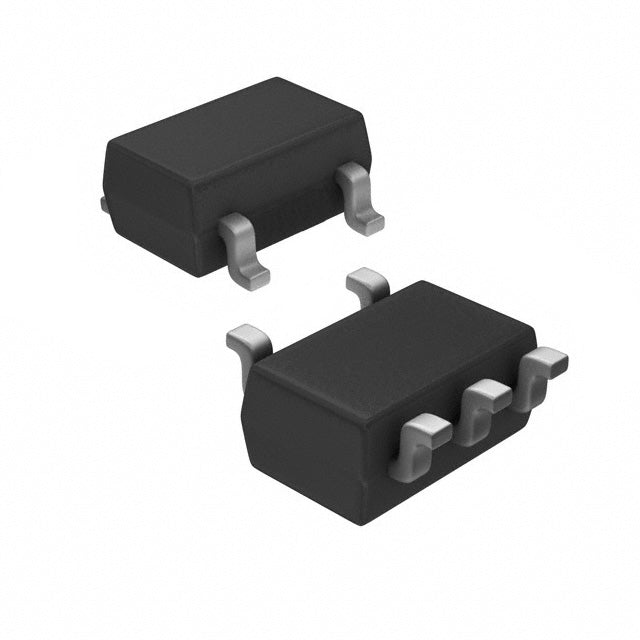
Union Semiconductor International Limited UM1460S-50

| Quantity | Unit Price | Total Price |
|---|---|---|
| 1 | $2.64 | $2.64 |
| 15+ | $0.61 | $9.15 |
| 25+ | $0.59 | $14.75 |
| 50+ | $0.56 | $28.00 |
| 100+ | $0.50 | $50.00 |
| N+ | $0.10 | Price Inquiry |
Request Quote / Inquiry
| Product attributes | Property Value |
| Manufacturer | Union Semiconductor International Limited |
| Product Series | UM1460 |
| Packaging | Tape & Reel (TR) | |
| Output Configuration | Positive |
| Output Type | Fixed |
| Number of Regulators | 1 |
| Voltage - Input (Max) | 16V |
| Voltage - Output (Min/Fixed) | 5V |
| Voltage - Output (Max) | - |
| Voltage Dropout (Max) | 0.3V @ 150mA |
| Current - Output | 250mA |
| Current - Quiescent (Iq) | 5 µA |
| Current - Supply (Max) | - |
| PSRR | 40dB (100Hz) |
| Control Features | Enable |
| Protection Features | - |
| Operating Temperature | -40°C ~ 85°C (TA) |
| Grade | - |
| Qualification | - |
| Mounting Type | Surface Mount |
| Package / Case | SC-74A, SOT-753 |
| Supplier Device Package | SOT-23-5 |
| ROHS |  |
The UM1460S-50 is a low dropout linear regulator from Union Semiconductor, delivering a fixed 5.0V output with up to 250mA of current. Its ultra-low 5 µA quiescent current makes it perfect for battery-powered and always-on applications. The SOT-23-5 package offers a small footprint, while the 0.3V dropout at 150mA ensures efficient operation. With 40dB PSRR at 100Hz, it provides clean power for noise-sensitive circuits.
- Ultra-Low Quiescent Current: 5 µA quiescent current significantly extends battery life in standby mode.
- High Output Current: 250mA capability supports a wide range of loads, from sensors to microcontrollers.
- Compact SOT-23-5 Package: Small size ideal for space-constrained PCB layouts.
- Excellent Ripple Rejection: 40dB PSRR at 100Hz ensures stable output in noisy environments.
USB Peripheral Power
Provides a clean 5.0V rail for USB peripherals like dongles and small hubs, with 250mA capability for downstream devices and low dropout from a 5V USB source.
Battery-Powered Instruments
The 5V output is ideal for powering analog front-ends and op-amps in portable multimeters and signal generators, with 5 µA quiescent current preserving battery life.
Automotive Aftermarket Sensors
For 5V automotive sensors, this LDO offers stable regulation from a 12V battery, with 40dB PSRR at 100Hz rejecting alternator noise.
Industrial Process Control
Powers 5V microcontrollers and communication interfaces in PLCs and field transmitters, ensuring reliable operation in noisy industrial environments.
Consumer Electronics
Provides a stable 5V supply for set-top boxes, routers, and smart speakers, with the SOT-23-5 package fitting into compact enclosures.
LED Lighting Controllers
Supplies 5V to LED driver control logic and wireless dimming modules, with low dropout maintaining regulation during load transients.
- Q: What is the output voltage of the UM1460S-50?
- A: The UM1460S-50 provides a fixed output voltage of 5.0V.
- Q: What is the maximum output current?
- A: It can deliver up to 250mA of output current.
- Q: What is the input voltage range?
- A: The input voltage range is not specified in the provided data; please refer to the official datasheet.
- Q: What is the dropout voltage?
- A: The dropout voltage is 0.3V at a 150mA load.
- Q: What is the quiescent current?
- A: The quiescent current is very low at 5 µA.
- Q: What package is available?
- A: It is available in the SOT-23-5 package.
 UM1460S-50.pdf
- Q: What is the output voltage of the UM1460S-50?
- A: The UM1460S-50 provides a fixed output voltage of 5.0V.
- Q: What is the maximum output current?
- A: It can deliver up to 250mA of output current.
- Q: What is the input voltage range?
- A: The input voltage range is not specified in the provided data; please refer to the official datasheet.
- Q: What is the dropout voltage?
- A: The dropout voltage is 0.3V at a 150mA load.
- Q: What is the quiescent current?
- A: The quiescent current is very low at 5 µA.
- Q: What package is available?
- A: It is available in the SOT-23-5 package.